ECT Oekotoxikologie GmbH
  • Home
  • About Us
    • Our expertise
    • Management
    • Activities in SETAC
    • Good Laboratory Practice (GLP)
  • Testing
    • Analytical chemistry
    • Aquatic Organisms
    • Sediment Organisms
    • Terrestrial Organisms
    • Dung Organisms
    • Bioaccumulation
    • Environmental Fate
    • Taxonomy
    • Waste
    • Wastewater
  • Consultancy
    • Industrial Chemicals
    • Pharmaceuticals
    • Biocides
    • Plant Protection Products
    • Mixtures
    • Waste
    • Organisation of Workshops & Meetings
    • Training Activities
  • Standardisation
    • OECD activities
    • ISO activities
    • Other standardisation organisations
  • Research
    • Current research projects
    • Projects supported by the European Union (EU)
    • Projects supported by German organisations
    • Projects supported by other organisations
    • All projects
    • Publications
  • News
  • Click to open the search input field Click to open the search input field Search
  • Menu Menu
You are here: Home1 / News2 / Report published on further development of screening tests for the evaluation...
Report published on further development of screening tests for the evaluation of potential PBT substancesT. Junker

Report published on further development of screening tests for the evaluation of potential PBT substances

January 2023

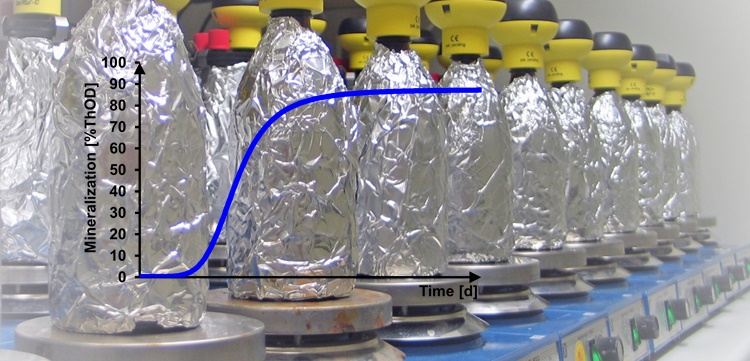
Different ready biodegradability tests (OECD 301 series and OECD 310) are currently used for evaluating if a substance is readily biodegradable and for identifying potentially persistent substances. Although the methods differ considerably, the test results are considered equivalent. In persistency assessments under REACH, enhanced ready biodegradability tests with an extended test duration (up to 60 days) and an increased test vessel size can be performed in cases where, based on ready biodegradability test results, a substance cannot be classified as non-persistent under environmental conditions. However, only few data from such enhanced tests are available and neither guidance on the design and interpretation, nor suitable validity criteria have been established so far.

In the present report, recommendations are given for further development and standardisation of screening tests for the evaluation of potential PBT substances in order to improve comparability of the test results. Additional knowledge is generated regarding the application of enhanced ready biodegradability tests.

A survey was performed among European laboratories to identify their experiences with ready biodegradability testing. The results were discussed during an international workshop in April 2019. Laboratory experiments were performed for five test substances to verify the impact of enhancements (an extended test duration and an increased test vessel size) on the results of ready biodegradability tests. The use of final effluent from a sewage treatment plant as an alternative inoculum was investigated, and tests with parallel determination of different endpoints (O2 consumption, CO2 evolution, DOC removal) were performed. The testing experience led to suggestions regarding the test design, the evaluation and the interpretation of enhanced ready biodegradability tests, which can be used as a starting point for further guidance. The impact of the proposed recommendations for the persistence assessment under REACH is discussed.

For further information, see the project report:

Gartiser, S., Brunswik-Titze, A., Flach, F., Junker, T. (2023). Further development of screening tests for the evaluation of potential PBT substances. UBA-Texte 10/2023.

For additional information on the project, see here.

Detailed information on the practical testing is provided in the following publication:

Gartiser, S., Brunswik-Titze, A., Flach, F., Junker, T., Sättler, D., Jöhncke, U. (2022). Enhanced ready biodegradability screening tests for the evaluation of potential PBT substances. Science of the Total Environment 833:155134.

Tags: biodegradation, enhanced ready biodegradability, enhanced ready test, environmental persistence, persistence, persistence screening, REACH

Our expert

Dr. Thomas Junker
Phone: +49 6145 9564-60
Mail Contact

Find us at

ECT Oekotoxikologie GmbH
Böttgerstraße 2 – 14
65439 Flörsheim am Main
Germany

Phone: +49 6145 9564-0
Fax: +49 6145 9564-99

About ECT

ECT Oekotoxikologie GmbH was founded as a privately owned, independent enterprise in 1993, and joined the SynTech Research Group in November 2021.

In compliance with Good Laboratory Practice (GLP), we perform standardised ecotoxicological tests in the laboratory as well as at semi-field and field level.

An overview of the ecotoxicology services provided by the whole SynTech Research Group is given here.

Recent Posts

  • Meet ECT and the SynTech Research Group at the SETAC Europe 36th Annual Meeting
  • New publications on the effects of plant protection products on soil organisms
  • New project: Soil biodiversity baseline survey

Pages

  • Testing
  • Consultancy
  • Standardisation
  • Research
  • News
  • Jobs
  • About Us

Find us at

ECT Oekotoxikologie GmbH
Böttgerstraße 2 – 14
65439 Flörsheim am Main
Germany

Phone: +49 6145 9564-0
Fax: +49 6145 9564-99

©2011-2026 ECT Oekotoxikologie GmbH. All rights reserved • Webdesign: inspiras Webagentur Frankfurt
  • Home
  • Imprint
  • Privacy Policy
  • Photo credits
Link to: Jörg Römbke is retiring at the end of 2022 Link to: Jörg Römbke is retiring at the end of 2022 Jörg Römbke is retiring at the end of 2022Jörg Römbke is retiring at the end of 2022 Link to: Report ‘Soil monitoring in Europe’ now published Link to: Report ‘Soil monitoring in Europe’ now published Report on soil monitoring in Europe publishedK. DuisReport ‘Soil monitoring in Europe’ now published
Scroll to top Scroll to top Scroll to top