
ECT Oekotoxikologie GmbH
  • Home
  • About Us
    • Our expertise
    • Management
    • Activities in SETAC
    • Good Laboratory Practice (GLP)
  • Testing
    • Analytical chemistry
    • Aquatic Organisms
    • Sediment Organisms
    • Terrestrial Organisms
    • Dung Organisms
    • Bioaccumulation
    • Environmental Fate
    • Taxonomy
    • Waste
    • Wastewater
  • Consultancy
    • Industrial Chemicals
    • Pharmaceuticals
    • Biocides
    • Plant Protection Products
    • Mixtures
    • Waste
    • Organisation of Workshops & Meetings
    • Training Activities
  • Standardisation
    • OECD activities
    • ISO activities
    • Other standardisation organisations
  • Research
    • Current research projects
    • Projects supported by the European Union (EU)
    • Projects supported by German organisations
    • Projects supported by other organisations
    • All projects
    • Publications
  • News
  • Click to open the search input field Click to open the search input field Search
  • Menu Menu
You are here: Home1 / Testing2 / Fish short-term reproduction assay (OECD 229)
Fish short-term reproduction assayK. Duis, M. Weil

Fish short-term reproduction assay (OECD 229)

October 2024

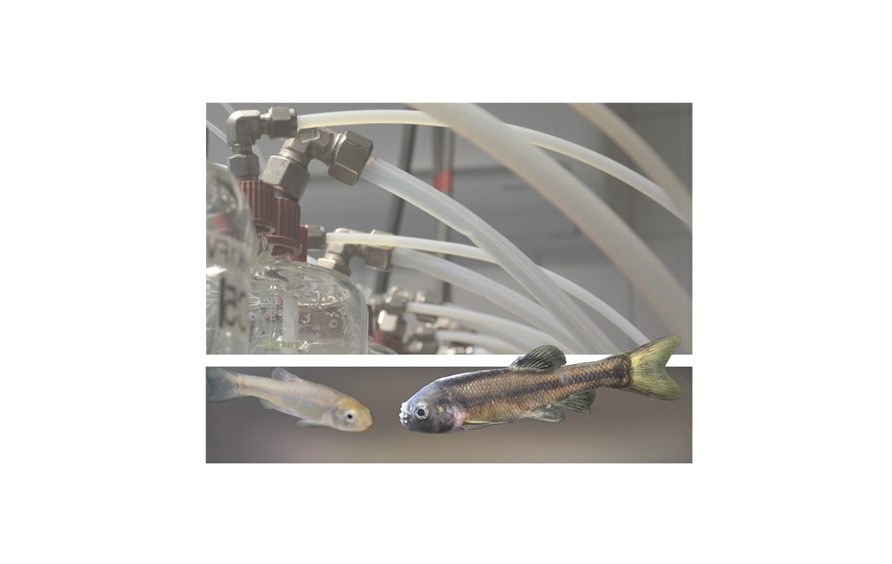
The fish short-term reproduction test is an in vivo screening assay that provides information about possible endocrine-mediated effects on adult fish. Within the OECD Conceptual framework for the testing and assessment of endocrine disrupting chemicals, it is a level 3 assay. We perform this test according to OECD test guideline 229 (Fish short-term reproduction assay, revised in 2012) in compliance with Good Laboratory Practice (GLP). Our standard test species is the fathead minnow (Pimephales promelas), which is bred inhouse.

We also perform a further level 3 assay, the ‘21-day fish assay: a short-term screening for oestrogenic and androgenic activity, and aromatase inhibition’ according to OECD test guideline 230.

Adult fish are exposed to a series of concentrations of the test substance, and to control water. For difficult-to-test substances, OECD guidance document 23 is taken into account. If required, a solvent control is included. Generally, exposure is carried out under flow-through conditions. The actual concentrations of the test substance in the flow-through system are verified by our inhouse analytical facility, if required directly after sampling.

The main endpoints of the fish short-term reproduction test are reproduction (fecundity), vitellogenin levels and secondary sexual characteristics. Gonad histopathology and fertilisation rate are additional optional endpoints.

Laboratories conducting this assay must demonstrate their ability by performing a technical proficiency study with reference compounds. ECT has successfully completed such a technical proficiency study with fathead minnows using three reference substances: 17ß-estradiol as reference for estrogenic activity, prochloraz as reference for aromatase inhibition and 17ß-trenbolone as reference for androgenic activity. The results for all three reference compounds were exactly as expected based on the OECD guidance and OECD validation studies (read more).


Tags: environmental risk assessment, fathead minnow, fish short-term reproduction assay, fish short-term reproduction test, Pimephales promelas

Our experts

Daniel Gilberg
Phone: +49 6145 9564-65
Mail Contact

Dr. Mirco Weil
Phone: +49 6145 9564-11
Mail Contact

Dr. Anja Coors
Phone: +49 6145 9564-20
Mail Contact

Find us at

ECT Oekotoxikologie GmbH
Böttgerstraße 2 – 14
65439 Flörsheim am Main
Germany

Phone: +49 6145 9564-0
Fax: +49 6145 9564-99

About ECT

ECT Oekotoxikologie GmbH was founded as a privately owned, independent enterprise in 1993, and joined the SynTech Research Group in November 2021.

In compliance with Good Laboratory Practice (GLP), we perform standardised ecotoxicological tests in the laboratory as well as at semi-field and field level.

An overview of the ecotoxicology services provided by the whole SynTech Research Group is given here.

Recent Posts

  • Renewed approval for R&D activities for private companies
  • Meet ECT and the SynTech Research Group at the SETAC Europe 36th Annual Meeting
  • New publications on the effects of plant protection products on soil organisms

Pages

  • Testing
  • Consultancy
  • Standardisation
  • Research
  • News
  • Jobs
  • About Us

Find us at

ECT Oekotoxikologie GmbH
Böttgerstraße 2 – 14
65439 Flörsheim am Main
Germany

Phone: +49 6145 9564-0
Fax: +49 6145 9564-99

©2011-2026 ECT Oekotoxikologie GmbH. All rights reserved • Webdesign: inspiras Webagentur Frankfurt
  • Home
  • Imprint
  • Privacy Policy
  • Photo credits
Link to: Report published on HP 14 classification of mirror entries in the List of Wastes Link to: Report published on HP 14 classification of mirror entries in the List of Wastes Report published on HP 14 classification of mirror entries in the List of W...Report published on HP 14 classification of mirror entries in the List of WastesR. Ketelhut Link to: New publication on TKTD modeling of sublethal endpoints for time‐variable toxicant exposure of <em>Ceriodaphnia</em> Link to: New publication on TKTD modeling of sublethal endpoints for time‐variable toxicant exposure of <em>Ceriodaphnia</em> New publication on TKTD modeling of sublethal endpoints for time‐variable toxicant exposure of CeriodaphniaK. DuisNew publication on TKTD modeling of sublethal endpoints for time‐variable...
Scroll to top Scroll to top Scroll to top