
ECT Oekotoxikologie GmbH
  • Home
  • About Us
    • Our expertise
    • Management
    • Activities in SETAC
    • Good Laboratory Practice (GLP)
  • Testing
    • Analytical chemistry
    • Aquatic Organisms
    • Sediment Organisms
    • Terrestrial Organisms
    • Dung Organisms
    • Bioaccumulation
    • Environmental Fate
    • Taxonomy
    • Waste
    • Wastewater
  • Consultancy
    • Industrial Chemicals
    • Pharmaceuticals
    • Biocides
    • Plant Protection Products
    • Mixtures
    • Waste
    • Organisation of Workshops & Meetings
    • Training Activities
  • Standardisation
    • OECD activities
    • ISO activities
    • Other standardisation organisations
  • Research
    • Current research projects
    • Projects supported by the European Union (EU)
    • Projects supported by German organisations
    • Projects supported by other organisations
    • All projects
    • Publications
  • News
  • Click to open the search input field Click to open the search input field Search
  • Menu Menu
You are here: Home1 / News2 / New publication: Impact of an immunosuppressive human pharmaceutical on...
Impact of an immunosuppressive human pharmaceutical on the interaction of a bacterial parasite and its invertebrate hostL. Schlüter-Vorberg

New publication: Impact of an immunosuppressive human pharmaceutical on the interaction of a bacterial parasite and its invertebrate host

November 2018

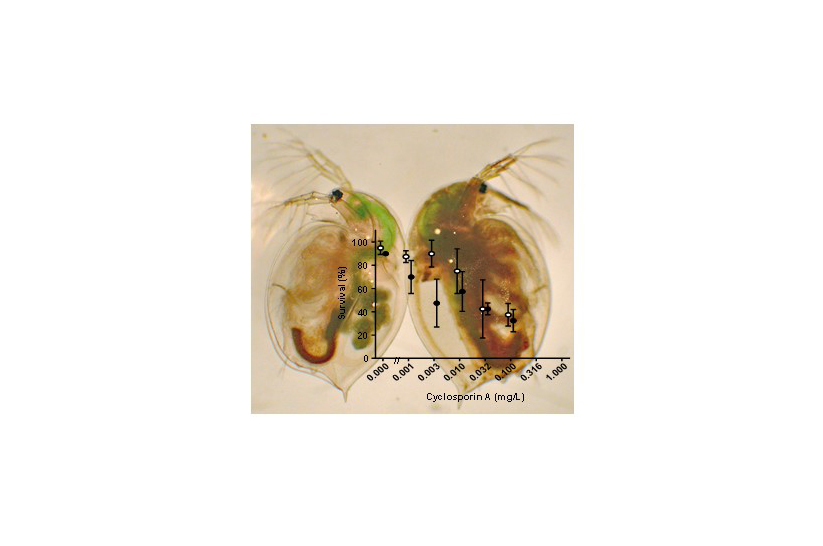
The interaction of pollutants and pathogens may result in altered (often enhanced) effects of the chemical, the biotic stressor or both. While standardised detection methods for immunotoxic effects of chemicals exist with regard to human health, such test systems are lacking for invertebrate species and no guidance is available on how immunotoxic effects of a chemical in invertebrates could be identified. In the present study, the impact of the immunosuppressive pharmaceutical cyclosporine A on the invertebrate host-pathogen system Daphnia magna – Pasteuria ramosa was investigated. Cyclosporine A is a calcineurin-inhibitor in vertebrates and has antibiotic and antifungal properties. Juvenile D. magna were exposed to cyclosporine A for 21 d with or without pathogen challenge during the first 72 h of exposure. Survival of D. magna was synergistically impacted by co-exposure to the chemical and the pathogen. Additionally, enhanced virulence of the pathogen upon chemical co-exposure was evident: an increased proportion of infected hosts and an increased speed of Pasteuria-induced host sterilisation. In Pasteuria-challenged but finally non-infected D. magna, effects on reproduction were additive. The present study provides evidence that a pharmaceutical intended to suppress the human immune system can also reduce disease resistance of an aquatic invertebrate organism at otherwise non-toxic concentrations. Plausible ways of interactions of cyclosporine A with the host’s immune system are an interference with phagocytosis or Toll-like receptors. Experimental verification of such an interference would be warranted to support the strong evidence for immunotoxic activity of cyclosporine A in invertebrates. While it remains open whether cyclosporine A concentrations in the environment are high enough to trigger adverse effects in environmental organisms, our findings highlight the need to consider immunotoxicity in an environmental risk assessment, and to develop suitable standardised methods for this purpose.

For additional information, see the publication in Aquatic Toxicology:

Schlüter-Vorberg, L., Coors, A. (2019). Impact of an immunosuppressive human pharmaceutical on the interaction of a bacterial parasite and its invertebrate host. Aquatic Toxicology 206, 91-101.

For further new publications, see ECT’s publication list.

Tags: aquatic environment, Daphnia, Daphnia magna, environmental risk assessment, host-pathogen system, immunosuppression, immunotoxicity

Our experts

Dr. Anja Coors
Phone: +49 6145 9564-20
Mail Contact

Dr. Lisa Schlüter-Vorberg
Phone: +49 6145 9564-75
Mail Contact

Find us at

ECT Oekotoxikologie GmbH
Böttgerstraße 2 – 14
65439 Flörsheim am Main
Germany

Phone: +49 6145 9564-0
Fax: +49 6145 9564-99

About ECT

ECT Oekotoxikologie GmbH was founded as a privately owned, independent enterprise in 1993, and joined the SynTech Research Group in November 2021.

In compliance with Good Laboratory Practice (GLP), we perform standardised ecotoxicological tests in the laboratory as well as at semi-field and field level.

An overview of the ecotoxicology services provided by the whole SynTech Research Group is given here.

Recent Posts

  • Renewed approval for R&D activities for private companies
  • Meet ECT and the SynTech Research Group at the SETAC Europe 36th Annual Meeting
  • New publications on the effects of plant protection products on soil organisms

Pages

  • Testing
  • Consultancy
  • Standardisation
  • Research
  • News
  • Jobs
  • About Us

Find us at

ECT Oekotoxikologie GmbH
Böttgerstraße 2 – 14
65439 Flörsheim am Main
Germany

Phone: +49 6145 9564-0
Fax: +49 6145 9564-99

©2011-2026 ECT Oekotoxikologie GmbH. All rights reserved • Webdesign: inspiras Webagentur Frankfurt
  • Home
  • Imprint
  • Privacy Policy
  • Photo credits
Link to: Further development of simple test systems for the evaluation of potential PBT substances: How to bridge the gap between screening tests and complex studies? Link to: Further development of simple test systems for the evaluation of potential PBT substances: How to bridge the gap between screening tests and complex studies? Further development of simple test systems for the evaluation of potential PBT...Further development of simple test systems for the evaluation of potential PBT substancesT. Junker Link to: Development and standardisation of an ecotoxicity test with fungus gnat larvae for the risk assessment of genetically modified plants Link to: Development and standardisation of an ecotoxicity test with fungus gnat larvae for the risk assessment of genetically modified plants Development and standardisation of an ecotoxicological test method using fungus gnat larvae for the risk assessment of genetically modified plantsK. DuisDevelopment and standardisation of an ecotoxicity test with fungus gnat larvae...
Scroll to top Scroll to top Scroll to top