
 L. Schlüter-Vorberg
Characterization, communication and minimization of risks originating from emerging contaminants and pathogens in the water cycle (TransRisk)

The presence of emerging contaminants and pathogens in the water cycle may pose a risk to humans and the environment. It is known that municipal wastewater treatment plants currently cannot remove all pathogens and anthropogenic micropollutants such as drug residues, cosmetics, or additives of food and industrial products from the wastewater. Advanced treatment methods such as ozonation or filtration techniques can considerably improve the elimination efficiency. Yet, particularly ozonation results in the formation of transformation products of mostly unknown identity and toxicity.
The chronic effects of wastewater treated by various advanced methods (including ozonation with different follow-up filtration treatments) were investigated in the present project by exposing selected aquatic organisms in situ in flow-through systems. The results demonstrated that advanced treatment methods can result in improved as well as impaired reproduction and growth of the exposed aquatic organisms. Clear evidence for the formation of toxic transformation products by ozonation was not detected in these investigations. Observed negative effects could rather be traced back to relatively high concentrations of certain nitrogen species (ammonium and nitrite), while observed positive effects could be explained by improved nutrimental conditions for the exposed organisms. In contrast, clear evidence for species-specific toxicity was found in laboratory tests with transformation products of the antiviral acyclovir, which are formed during (advanced) wastewater treatment. While the determined effect concentrations of these transformation products in relation to their measured environmental concentrations did not indicate immediate environmental risks, these results underline that ozonation as advanced wastewater treatment method can lead to the formation of transformation products that are more toxic than the parent compound.
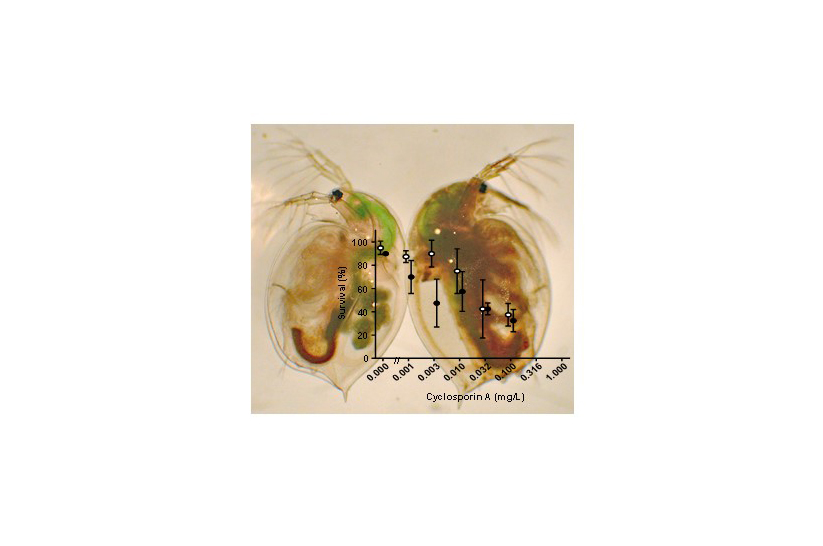
As an additional research topic, the combined effects of pollutants and pathogens on invertebrate organisms were studied by ECT in the present project. A literature study on this topic was conducted and supported by experimental work with the host-parasite system Daphnia magna & Pasteuria ramosa. While the investigated wastewaters did not show any indication of immunotoxic potential, individual test substances (among them the immunosuppressive cyclosporine) were found to exhibit signs of a specific immunotoxic effect in the invertebrate host. These results support the further development of this host-parasite system into a test system for detection of immunotoxicity in invertebrates.
Further information can be found in the following publications:
Schlüter-Vorberg, L., Prasse, C., Ternes, T.A., Mückter, H., Coors, A. (2015). Toxification by transformation in conventional and advanced wastewater treatment: the antiviral drug acyclovir. Environmental Science & Technology Letters 2 (12), 342-346 [read more]
Ternes, T.A., Prasse, C., Eversloh, C.L., Knopp, G., Cornel, P., Schulte-Oehlmann, U., Schwartz, T., Alexander, J., Seitz, W., Coors, A., Oehlmann, J. (2017). Integrated evaluation concept to assess the efficacy of advanced wastewater treatment processes for the elimination of micropollutants and pathogens. Environmental Science & Technology 51, 308-319. [read more]
Ternes, T., Abbas, A., Alexander, J., Bollmann, A., Coors, A., Cornel, P., Durmaz, V., Funke, J., Geißen, S., Götz, K., Knopp, G., Lütke Eversloh, C., Krauße, U., Mückter, H., Niethammer, M., Prasse, C., Schneider, I., Schwartz, T., Seitz, W., Schulte-Oehlmann, U., Oehlmann, J., Thaler, S., Schlüter-Vorberg, L., Weber, M., Wieland, A., Szewzyk, U. (2017). Anthropogene Spurenstoffe, Krankheitserreger und Antibiotikaresistenzen im Wasserkreislauf – Relevanz, Monitoring und Eliminierung. DWA-Themen, Januar 2017. Deutsche Vereinigung für Wasserwirtschaft, Abwasser und Abfall e.V., Hennef, Germany. [read more]
Schlüter-Vorberg, L., Knopp, G., Cornel, P., Ternes, T., Coors, A. (2017). Survival, reproduction, growth, and parasite resistance of aquatic organisms exposed on-site to wastewater treated by advanced treatment processes. Aquatic Toxicology 186, 171-179. [read more]
Schlüter-Vorberg, L., Coors, A. (2019). Impact of an immunosuppressive human pharmaceutical on the interaction of a bacterial parasite and its invertebrate host. Aquatic Toxicology 206, 91-101. [read more]
Last update: April 2019

