
ECT Oekotoxikologie GmbH
  • Home
  • About Us
    • Our expertise
    • Management
    • Activities in SETAC
    • Good Laboratory Practice (GLP)
  • Testing
    • Analytical chemistry
    • Aquatic Organisms
    • Sediment Organisms
    • Terrestrial Organisms
    • Dung Organisms
    • Bioaccumulation
    • Environmental Fate
    • Taxonomy
    • Waste
    • Wastewater
  • Consultancy
    • Industrial Chemicals
    • Pharmaceuticals
    • Biocides
    • Plant Protection Products
    • Mixtures
    • Waste
    • Organisation of Workshops & Meetings
    • Training Activities
  • Standardisation
    • OECD activities
    • ISO activities
    • Other standardisation organisations
  • Research
    • Current research projects
    • Projects supported by the European Union (EU)
    • Projects supported by German organisations
    • Projects supported by other organisations
    • All projects
    • Publications
  • News
  • Click to open the search input field Click to open the search input field Search
  • Menu Menu
You are here: Home1 / Research2 / Projects supported by German organisations3 / Development of ecotoxicological tests with biocides and eluates: verification...

Development of ecotoxicological tests with biocides and eluates: verification of the suitability of the embryo test with the zebrafish (Danio rerio, DarT)

January 2011

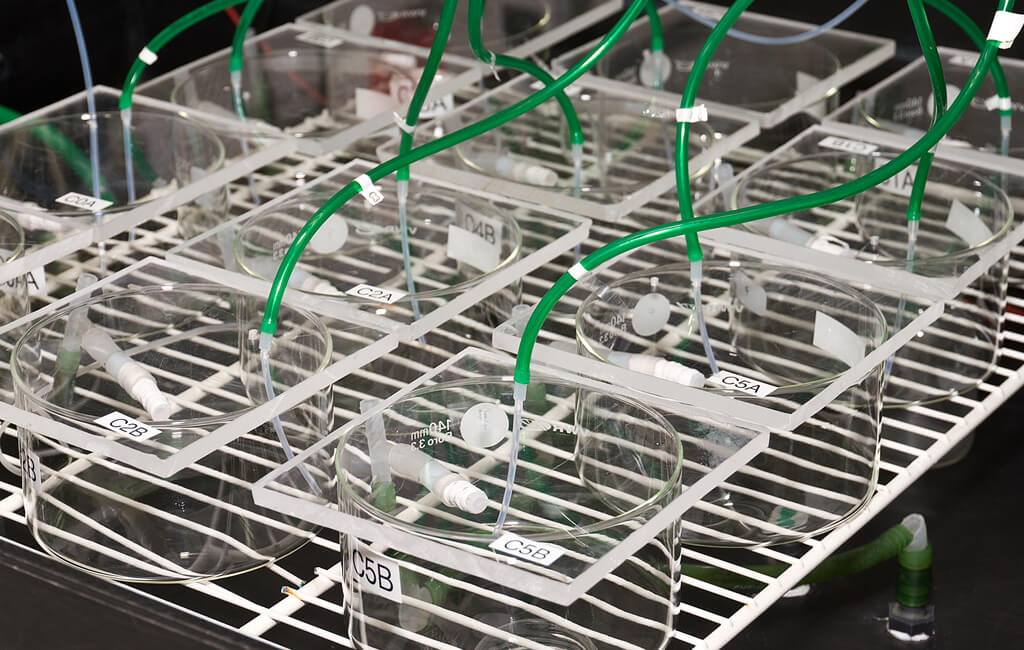
The project explored the suitability of the fish embryo toxicity test with the zebrafish, Danio rerio, (DarT) as a tool to screen for additive and non-additive effects among biocidal substances. Five biocidal products from the product type 8 (curative and preventive wood preservatives) and their individual active substances were tested in the DarT. Overall, the results provided clear evidence that the DarT can be used to verify if the toxicity of formulated biocidal products can reliably be predicted by the concept of concentration addition. This may open the possibility to replace vertebrate (adult or juvenile fish) testing by mixture toxicity predictions in justified cases.

Tags: biocidal products, biocides, Danio rerio, fish embryo test, mixture toxicity, mixture toxicity prediction, wood preservative, zebrafish

Supported by the German Environment Agency

Coordination by ECT Oekotoxikologie GmbH
2009 – 2010
FKZ 360 04 029

Partners

Helmholtz Centre for Environmental Research (UFZ), Leipzig

Our expert

Dr. Anja Coors
Phone: +49 6145 9564-20
Mail Contact

Find us at

ECT Oekotoxikologie GmbH
Böttgerstraße 2 – 14
65439 Flörsheim am Main
Germany

Phone: +49 6145 9564-0
Fax: +49 6145 9564-99

About ECT

ECT Oekotoxikologie GmbH was founded as a privately owned, independent enterprise in 1993, and joined the SynTech Research Group in November 2021.

In compliance with Good Laboratory Practice (GLP), we perform standardised ecotoxicological tests in the laboratory as well as at semi-field and field level.

An overview of the ecotoxicology services provided by the whole SynTech Research Group is given here.

Recent Posts

  • Meet ECT and the SynTech Research Group at the SETAC Europe 36th Annual Meeting
  • New publications on the effects of plant protection products on soil organisms
  • New project: Soil biodiversity baseline survey

Pages

  • Testing
  • Consultancy
  • Standardisation
  • Research
  • News
  • Jobs
  • About Us

Find us at

ECT Oekotoxikologie GmbH
Böttgerstraße 2 – 14
65439 Flörsheim am Main
Germany

Phone: +49 6145 9564-0
Fax: +49 6145 9564-99

©2011-2026 ECT Oekotoxikologie GmbH. All rights reserved • Webdesign: inspiras Webagentur Frankfurt
  • Home
  • Imprint
  • Privacy Policy
  • Photo credits
Link to: Review and enhancement of new risk assessment concepts under REACH Link to: Review and enhancement of new risk assessment concepts under REACH Review and enhancement of new risk assessment concepts under REACH Link to: Potential substances of very high concern based on environmental protection criteria of the REACH regulation: Verification by substance properties and prioritisation by relevance criteria Link to: Potential substances of very high concern based on environmental protection criteria of the REACH regulation: Verification by substance properties and prioritisation by relevance criteria Potential substances of very high concern based on environmental protection...
Scroll to top Scroll to top Scroll to top